

Discovering Folding Lines for Surface Compression
Download3757377.3763983.pdf (20.92Mb)
Publisher with Creative Commons License
Publisher with Creative Commons License
Creative Commons Attribution
Terms of use
Metadata
Show full item recordAbstract
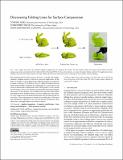
The miniaturization of shell structures presents a versatile and complex challenge, bridging geometry with diverse practical applications. In this paper, we introduce a novel approach for computing origami crease patterns to compress arbitrary 3D shell objects. First, we employ the adapted Material Point Method (MPM) to simulate the compression of a target surface and obtain an initial folded configuration. Since MPM produces overly smooth curved surfaces, their crease patterns are unsuitable for practical origami fabrication. We then propose a novel Folding Line Extraction (FLE) method that optimizes these smoothed surfaces to extract folding lines that achieve the target compression with minimal deformation and stretching outside the crease lines. This method produces smooth curved folding lines. Fabrication and experimental validation of the extracted patterns demonstrate their effectiveness and applicability in real-world scenarios.
Description
SA Conference Papers ’25, Hong Kong, Hong Kong
Date issued
2025-12-14Department
Massachusetts Institute of Technology. Department of Electrical Engineering and Computer SciencePublisher
ACM|SIGGRAPH Asia 2025 Conference Papers
Citation
Toshiki Aoki, Tomohiro Tachi, and Mina Konakovic Lukovic. 2025. Discovering Folding Lines for Surface Compression. In Proceedings of the SIGGRAPH Asia 2025 Conference Papers (SA Conference Papers '25). Association for Computing Machinery, New York, NY, USA, Article 98, 1–12.
Version: Final published version
ISBN
979-8-4007-2137-3