| dc.contributor.author | Doron, Dean | |
| dc.contributor.author | Pyne, Edward | |
| dc.contributor.author | Tell, Roei | |
| dc.contributor.author | Williams, R. Ryan | |
| dc.date.accessioned | 2026-01-26T16:27:49Z | |
| dc.date.available | 2026-01-26T16:27:49Z | |
| dc.date.issued | 2025-06-15 | |
| dc.identifier.isbn | 979-8-4007-1510-5 | |
| dc.identifier.uri | https://hdl.handle.net/1721.1/164636 | |
| dc.description | STOC ’25, Prague, Czechia | en_US |
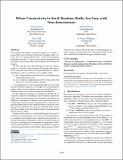
| dc.description.abstract | Two fundamental problems on directed graphs are to decide s-t connectivity, and to estimate the behavior of random walks. Currently, there is no known algorithm for s-t connectivity running in polynomial time and no(1) space, and no known algorithm for estimating the n-step random walk matrix running in non-deterministic logspace.
We show that for every directed graph, at least one of these problems is solvable in time and space that significantly improve on the respective state-of-the-art. In particular, there is a pair of algorithms A1 and A2 such that for every graph G, either:
A1(G) outputs the transitive closure of G in polynomial time and polylogarithmic space. A2(G) outputs an approximation of the n-step random walk matrix of G in non-deterministic logspace.
As one application, we show surprisingly tight win-win results for space-bounded complexity. For example, for certain parameter regimes, either Savitch’s theorem can be non-trivially sped up, or randomized space can be almost completely derandomized.
We also apply our techniques to significantly weaken the assumptions required to derandomize space-bounded computation, and to make non-deterministic space-bounded computation unambiguous. Specifically, we deduce such conclusions from lower bounds against uniform circuits of polynomial size, which is an exponential improvement on the required hardness in previous works (Doron–Pyne–Tell STOC 2024, Li–Pyne–Tell FOCS 2024). We further show similar results for minimal-memory derandomization (Doron–Tell CCC 2024).
To prove these results, we substantially improve the array of technical tools introduced in recent years for studying hardness-vs.-randomness for bounded-space computation. In particular, we develop derandomized distinguish-to-predict transformations for new types of distinguishers (corresponding to compositions of PRGs with weak distinguishers), we construct a derandomized logspace reconstruction procedure for the Shaltiel–Umans generator (JACM 2005) that can compress hard truth-tables to polylogarithmic size, and we design a version of the Chen–Tell generator (FOCS 2021) that is particularly suitable for the space-bounded setting. | en_US |
| dc.publisher | ACM|Proceedings of the 57th Annual ACM Symposium on Theory of Computing | en_US |
| dc.relation.isversionof | https://doi.org/10.1145/3717823.3718303 | en_US |
| dc.rights | Creative Commons Attribution-NonCommercial-NoDerivatives | en_US |
| dc.rights.uri | https://creativecommons.org/licenses/by-nc-nd/4.0/ | en_US |
| dc.source | Association for Computing Machinery | en_US |
| dc.title | When Connectivity Is Hard, Random Walks Are Easy with Non-determinism | en_US |
| dc.type | Article | en_US |
| dc.identifier.citation | Dean Doron, Edward Pyne, Roei Tell, and R. Ryan Williams. 2025. When Connectivity Is Hard, Random Walks Are Easy with Non-determinism. In Proceedings of the 57th Annual ACM Symposium on Theory of Computing (STOC '25). Association for Computing Machinery, New York, NY, USA, 1108–1117. | en_US |
| dc.contributor.department | Massachusetts Institute of Technology. Department of Electrical Engineering and Computer Science | en_US |
| dc.identifier.mitlicense | PUBLISHER_POLICY | |
| dc.eprint.version | Final published version | en_US |
| dc.type.uri | http://purl.org/eprint/type/ConferencePaper | en_US |
| eprint.status | http://purl.org/eprint/status/NonPeerReviewed | en_US |
| dc.date.updated | 2025-08-01T08:47:08Z | |
| dc.language.rfc3066 | en | |
| dc.rights.holder | The author(s) | |
| dspace.date.submission | 2025-08-01T08:47:08Z | |
| mit.license | PUBLISHER_CC | |
| mit.metadata.status | Authority Work and Publication Information Needed | en_US |