| dc.contributor.author | Ellison, Mark D | |
| dc.contributor.author | Allen, Jacqueline | |
| dc.contributor.author | Bonfiglio, Michael | |
| dc.contributor.author | Seeburger, Matthew | |
| dc.contributor.author | Setenet, Jean | |
| dc.contributor.author | DiGinto, Biagio | |
| dc.contributor.author | Bonanny, Harrison | |
| dc.contributor.author | Russell, Aaliyah | |
| dc.contributor.author | Baird, David | |
| dc.contributor.author | Davis, Liana | |
| dc.contributor.author | McCarthy, Ella | |
| dc.contributor.author | Manley, Alyson | |
| dc.contributor.author | Blatt, Sarah | |
| dc.contributor.author | Lippe, David | |
| dc.contributor.author | Ragone, Daniel | |
| dc.contributor.author | Dyer, Brock | |
| dc.contributor.author | Osgood, Jillian | |
| dc.contributor.author | Strano, Michael S | |
| dc.date.accessioned | 2026-01-22T21:55:40Z | |
| dc.date.available | 2026-01-22T21:55:40Z | |
| dc.date.issued | 2025-03-11 | |
| dc.identifier.uri | https://hdl.handle.net/1721.1/164621 | |
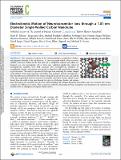
| dc.description.abstract | The transport of cations of the neurotransmitters acetylcholine, choline, and dopamine through a 1.01 nm-diameter, 1.1 mm-long single-walled carbon nanotube (SWNT) has been studied for the first time. As a comparison, sodium and aniline ion transport was also investigated. All of these ions exhibited significantly enhanced electrophoretic mobilities over bulk transport. The electrophoretic mobilities of acetylcholine, choline, and sodium were found to depend on pH, specifically increasing as pH decreases. This result is explained by hydrogen ions saturating the surface charges of the SWNT. Conversely, dopamine and aniline have mobilities that do not depend on pH. This difference is attributed to the benzene ring and the size of these ions. An analysis of the time required for an ion to traverse the nanotube shows that the ions adsorb to and desorb from the walls as they pass through the tube. Acetylcholine, choline, and sodium show desorption rate constants that decrease with increasing pH, whereas dopamine and aniline have rate constants that remain constant over different pH values. This is consistent with the relationship between adsorption and desorption rate constants and mobility from an adsorption/desorption kinetic model. | en_US |
| dc.language.iso | en | |
| dc.publisher | American Chemical Society | en_US |
| dc.relation.isversionof | 10.1021/acs.jpcc.4c07482 | en_US |
| dc.rights | Creative Commons Attribution | en_US |
| dc.rights.uri | https://creativecommons.org/licenses/by/4.0/ | en_US |
| dc.source | American Chemical Society | en_US |
| dc.title | Electrokinetic Motion of Neurotransmitter Ions through a 1.01 nm Diameter Single-Walled Carbon Nanotube | en_US |
| dc.type | Article | en_US |
| dc.identifier.citation | Mark D. Ellison, Jacqueline Allen, Michael Bonfiglio, Matthew Seeburger, Jean Setenet, Biagio DiGinto, Harrison Bonanny, Aaliyah Russell, David Baird, Liana Davis, Ella McCarthy, Alyson Manley, Sarah Blatt, David Lippe, Daniel Ragone, Brock Dyer, Jillian Osgood, and Michael S. Strano. The Journal of Physical Chemistry C 2025 129 (11), 5472-5482. | en_US |
| dc.contributor.department | Massachusetts Institute of Technology. Department of Chemical Engineering | en_US |
| dc.relation.journal | The Journal of Physical Chemistry C | en_US |
| dc.eprint.version | Final published version | en_US |
| dc.type.uri | http://purl.org/eprint/type/JournalArticle | en_US |
| eprint.status | http://purl.org/eprint/status/PeerReviewed | en_US |
| dc.date.updated | 2026-01-22T21:50:19Z | |
| dspace.orderedauthors | Ellison, MD; Allen, J; Bonfiglio, M; Seeburger, M; Setenet, J; DiGinto, B; Bonanny, H; Russell, A; Baird, D; Davis, L; McCarthy, E; Manley, A; Blatt, S; Lippe, D; Ragone, D; Dyer, B; Osgood, J; Strano, MS | en_US |
| dspace.date.submission | 2026-01-22T21:50:23Z | |
| mit.journal.volume | 129 | en_US |
| mit.journal.issue | 11 | en_US |
| mit.license | PUBLISHER_CC | |
| mit.metadata.status | Authority Work and Publication Information Needed | en_US |