| dc.contributor.author | Zhan, Xiao | |
| dc.contributor.author | Jambon, Cl?ment | |
| dc.contributor.author | Thompson, Evan | |
| dc.contributor.author | Ng, Kenney | |
| dc.contributor.author | Konakovi? Lukovi?, Mina | |
| dc.date.accessioned | 2026-01-14T19:12:18Z | |
| dc.date.available | 2026-01-14T19:12:18Z | |
| dc.date.issued | 2025-12-14 | |
| dc.identifier.isbn | 979-8-4007-2137-3 | |
| dc.identifier.uri | https://hdl.handle.net/1721.1/164529 | |
| dc.description | SA Conference Papers ’25, Hong Kong, Hong Kong | en_US |
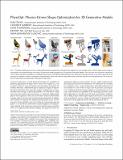
| dc.description.abstract | Generative models have recently demonstrated impressive capabilities in producing high-quality 3D shapes from a variety of user inputs (e.g., text or images). However, generated objects often lack physical integrity. We introduce PhysiOpt, a differentiable physics optimizer designed to improve the physical behavior of 3D generative outputs, enabling them to transition from virtual designs to physically plausible, real-world objects. While most generative models represent geometry as continuous implicit fields, physics-based approaches often rely on the finite element method (FEM), requiring ad hoc mesh extraction to perform shape optimization. In addition, these methods are typically slow, limiting their integration in fast, iterative generative design workflows. Instead, we bridge the representation gap and propose a fast and effective differentiable simulation pipeline that optimizes shapes directly in the latent space of generative models using an intuitive and easy-to-implement differentiable mapping. This approach enables fast optimization while preserving semantic structure, unlike traditional methods relying on local mesh-based adjustments. We demonstrate the versatility of our optimizer across a range of shape priors, from global and part-based latent models to a state-of-the-art large-scale 3D generator, and compare it to a traditional mesh-based shape optimizer. Our method preserves the native representation and capabilities of the underlying generative model while supporting user-specified materials, loads, and boundary conditions. The resulting designs exhibit improved physical behavior, remain faithful to the learned priors, and are suitable for fabrication. We demonstrate the effectiveness of our approach on both virtual and fabricated objects. | en_US |
| dc.publisher | ACM|SIGGRAPH Asia 2025 Conference Papers | en_US |
| dc.relation.isversionof | https://doi.org/10.1145/3757377.3763884 | en_US |
| dc.rights | Creative Commons Attribution | en_US |
| dc.rights.uri | https://creativecommons.org/licenses/by/4.0/ | en_US |
| dc.source | Association for Computing Machinery | en_US |
| dc.title | PhysiOpt: Physics-Driven Shape Optimization for 3D Generative Models | en_US |
| dc.type | Article | en_US |
| dc.identifier.citation | Xiao Zhan, Clément Jambon, Evan Thompson, Kenney Ng, and Mina Konaković Luković. 2025. PhysiOpt: Physics-Driven Shape Optimization for 3D Generative Models. In Proceedings of the SIGGRAPH Asia 2025 Conference Papers (SA Conference Papers '25). Association for Computing Machinery, New York, NY, USA, Article 109, 1–11. | en_US |
| dc.contributor.department | Massachusetts Institute of Technology. Department of Electrical Engineering and Computer Science | en_US |
| dc.contributor.department | MIT-IBM Watson AI Lab | en_US |
| dc.contributor.department | MIT-IBM Watson AI Lab | en_US |
| dc.identifier.mitlicense | PUBLISHER_POLICY | |
| dc.eprint.version | Final published version | en_US |
| dc.type.uri | http://purl.org/eprint/type/ConferencePaper | en_US |
| eprint.status | http://purl.org/eprint/status/NonPeerReviewed | en_US |
| dc.date.updated | 2026-01-01T08:53:13Z | |
| dc.language.rfc3066 | en | |
| dc.rights.holder | The author(s) | |
| dspace.date.submission | 2026-01-01T08:53:15Z | |
| mit.license | PUBLISHER_CC | |
| mit.metadata.status | Authority Work and Publication Information Needed | en_US |