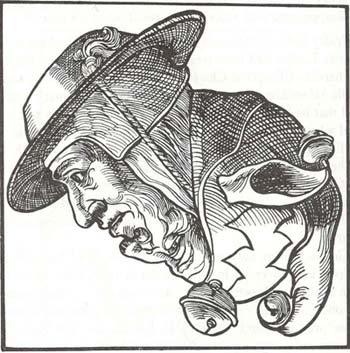
The woodcut reproduced below circulated in print in the 1520s. In one or two paragraphs, imagine how an observer would have responded to this image at that time. (Your observer might be from any European country, of any class and either sex; be sure to specify these details in your response.) The head on the top is that of a Cardinal in the Catholic church; that on the bottom represents a fool. (Image courtesy of Staatliche Graphische Sammlung, Munich, Germany. Used with permission.)
Write two essays, one in response to each of the two questions below. You may consult an outline of your essays, on a single sheet of 8.5 x 11 paper, but you may not consult any other books or notes during the exam.
1. Write an essay in which you support the following statement with reference to specific individuals, events, and developments from 1300 to 1600. "The achievements of Europeans during their Renaissance were unreservedly positive. In the fields of political theory and practice, religious doctrine, economic and territorial expansion, natural philosophy, and the arts and letters, the Renaissance paved the way for future European successes. The lives of Europeans by 1600 were more materially and spiritually satisfying than those of their predecessors three hundred years earlier."
2. Write an essay in which you support the following statement with reference to specific individuals, events, and developments from 1300 to 1600. "Although the period began with great promise in many fields, by 1600 the Renaissance had petered out, leaving political chaos, theological uncertainty, and cultural decadence in its wake. The unchecked power of despotic rulers oppressed women and the poor on the continent and non-Europeans in locations around the globe. By the late sixteenth century, efforts at spiritual reform that had been underway since the fourteenth century had resulted in the polarisation of Christianity and far more vigorous policing of religious belief and practice."